

Faster action
Immediate effectiveness
Ease & convenience
No swallowing difficulties
No gastrointestinal discomfort
Gentle on the stomach
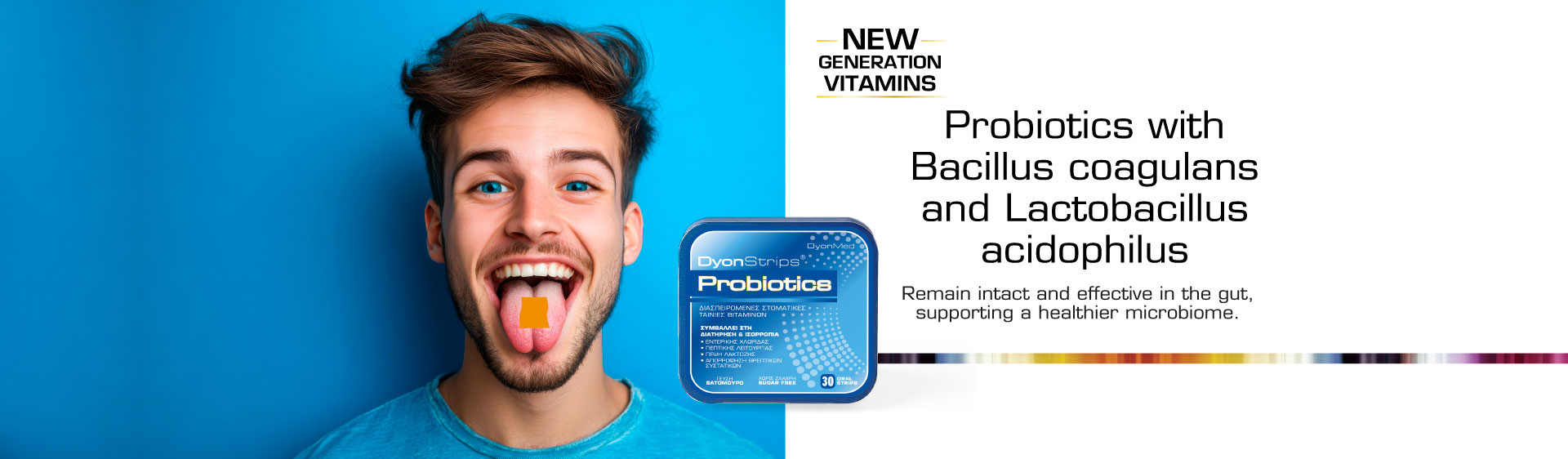
DyonMed, in collaboration with the world’s leading company in the development and production of oral strips, applies the innovative Oral Dissolving Films (ODF) technology, which enables the creation of thin films that dissolve rapidly in the mouth without water, releasing microencapsulated probiotics.
The use of micro-encapsulation and slow drying techniques improves the stability and viability of microorganisms during storage and passage through the gastrointestinal tract.
Spore-forming strains, such as Bacillus coagulans, are naturally resistant to temperature and pH, further enhancing their effectiveness.
Probiotics are not absorbed through the oral mucosa.
We utilize the second innovative mechanism of DyonStrips® Probiotics, designed to deliver live microorganisms directly to the intestine, where they act locally.

Advantages of the Probiotics DyonStrips® form
- Preservation of strain viability through freeze-drying and incorporation into a polymer film.
- Dissolution in the mouth allows partial absorption and activation at the oral mucosa.
- Delivery of live spores to the intestine, where they colonize and multiply.
- Improved compliance (no water needed, instant intake, no yeast taste or unpleasant aftertaste).
- For Vegans and Vegeterians:
• Reduction of bloating and indigestion.
• Support for the absorption of iron, zinc, and magnesium.
Patient Profiles / Customer Groups
- Co-administration with antibiotics
Support with probiotics during antibiotic therapy. - Irritable Bowel Syndrome (IBS)
Relief from bloating, pain, and motility disorders. - Intestinal dysbiosis / chronic constipation
Improvement of gut microbiota and bowel motility. - Immune support
Prevention of infections. - Inflammatory Bowel Disease (IBD) / pouchitis
In combination with medical treatment. - Patients on medication (PPIs, NSAIDs)
Prevention of inflammation and side effects. - Elderly
Support of intestinal microbioma. - Vegans and Vegetarians
Normal digestive function and enhanced nutrient absorption.
Total: 7 billion CFU/strip
Η δοσολογία αυτή βρίσκεται εντός των ορίων που προτείνονται βιβλιογραφικά για θεραπευτική δράση (5–10 δισ. CFU/ημέρα σε κλινικές μελέτες).
Dosage & Usage Instructions

Take 1 strip per day.
Place the strip above the tongue, the strip touches the palate and let it dissolve.
Composition
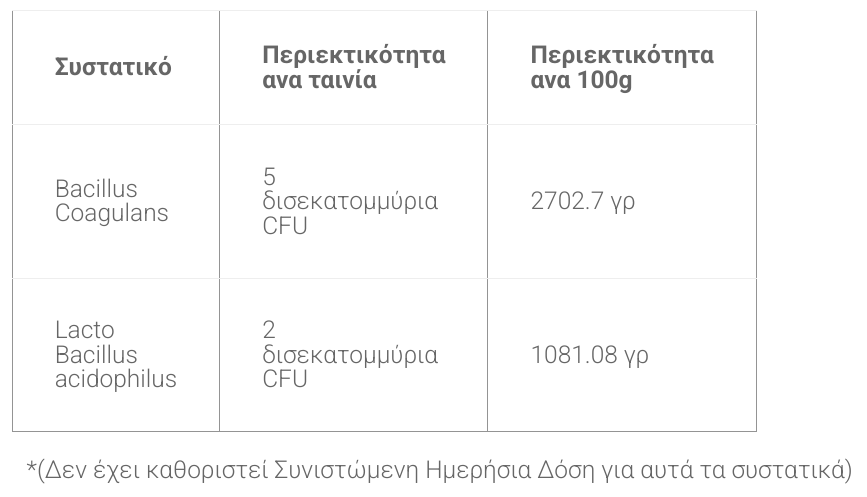
| Ingredient | Content per strip | Content per 100g |
| Bacillus Coagulans | 5 billion CFU | 2702.7 g |
| Lacto Bacillus acidophilus | 2 billion CFU | 1081.08 g |
*(No Recommended Daily Intake has been established for these ingredients
Σύνθεση
Ingredients
Bacillus Coagulans, Lacto Bacillus Acidophilus, Πουλουλάνη, Κυτταρίνη, Μηλικό Οξύ, Μαννιτόλη, Σιρόπι Σορβιτόλης, Λεκιθίνη, Φυσικό Άρωμα Μύρτιλου, Ερυθριτόλη, Γλυκοσίδες Στεβιόλης.
Who is it for, who can benefit?
After antibiotic therapy – Prevention of antibiotic-associated diarrhea (AAD).
The administration of probiotics during and immediately after antibiotic treatment has been shown to significantly reduce the risk of AAD (chronic diarrhea), which occurs in up to 30% of patients (Hempel et al., JAMA, 2012)..
The combination of strains such as Bacillus coagulans and Lactobacillus acidophilus has been studied in clinical trials and found to reduce the incidence of AAD and accelerate the restoration of normal gut microbiota (Goldenberg et al., Cochrane Review, 2017)..
BIBLIOGRAPHY
- Goldenberg JZ, et al. Probiotics for the prevention of Clostridium difficile-associated diarrhea in adults and children. Cochrane Database Syst Rev. 2017;12:CD006095.
- Ford AC, Harris LA, Lacy BE, Quigley EMM, Moayyedi P. Systematic review with meta-analysis: the efficacy of prebiotics, probiotics, synbiotics and antibiotics in irritable bowel syndrome. Aliment Pharmacol Ther. 2018;48(10):1044–1060.
- Su GL, Ko CW, Bercik P, et al. AGA Clinical Practice Guidelines on the Role of Probiotics in the Management of Gastrointestinal Disorders. Gastroenterology. 2020;159(2):697–705.
- Szajewska H, Kolodziej M. Systematic review with meta-analysis: Saccharomyces boulardii in the prevention of antibiotic-associated diarrhoea. Aliment Pharmacol Ther. 2015;42(7):793–801.
- Derwa Y, Gracie DJ, Hamlin PJ, Ford AC. Systematic review with meta-analysis: the efficacy of probiotics in inflammatory bowel disease. Aliment Pharmacol Ther. 2017;46(4):389–400.
- Mimura T, Rizzello F, Helwig U, et al. Once daily high dose probiotic therapy (VSL#3) for maintaining remission in recurrent or refractory pouchitis. Gut. 2004;53(1):108–114.
- Lu M, Yu S, Deng J, et al. Efficacy of probiotics in Helicobacter pylori eradication therapy: a meta-analysis of randomized controlled trials. Helicobacter. 2016;21(5):306–315.
- Majeed M, Majeed S, Nagabhushanam K, Arumugam S, Beede K, Ali F. Bacillus coagulans MTCC 5856 supplementation in the management of functional gastrointestinal symptoms: randomized, placebo-controlled trial. Food Nutr Res. 2016;60:29238.
- Sanders ME, Merenstein DJ, Reid G, Gibson GR, Rastall RA. Probiotics and prebiotics in intestinal health and disease: from biology to the clinic. Nat Rev Gastroenterol Hepatol. 2019;16(10):605–616.
- West NP, Horn PL, Pyne DB. Probiotics for gastrointestinal disorders: proposed recommendations for athletes and physically active people. Front Nutr. 2017;4:33.